
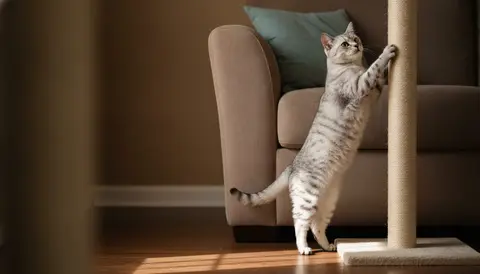
Why do cats scratch furniture? Scratching is a normal, necessary behavior for them, not an attempt to wreck anything. It keeps their claws in shape, leaves a scent and a visible mark, and gives them a full-body stretch. A sofa happens to be a tall, sturdy, grippy surface in the middle of their territory, which makes it an obvious target.
The way to stop a cat scratching furniture is to move the scratching elsewhere, not to stop the behavior itself. The ASPCA, the AAFP and Cats Protection all advise giving a cat something better to scratch and putting it where the cat already scratches. It also helps to reward the cat for using it and to make the furniture less appealing for a while. Punishment can backfire: in a 2022 survey of 2,465 owners, scolding and physical correction went with more unwanted scratching, not less.
Why do cats scratch?
| Reason | What is happening | What it means for you |
|---|---|---|
| Claw care | Scratching pulls off the worn outer layer of each claw and exposes the sharper one underneath (AAFP, ASPCA) | Every cat needs somewhere to do this. Claw husks left near a post are normal |
| Marking | Scent glands between the paw pads leave a smell, and the scratch marks leave a visible sign for other cats (Cats Protection, AAFP) | Cats tend to mark prominent places, such as the sofa in the main room, doorways and windows |
| Stretching | Pulling against a surface stretches the legs and back (AAFP, ASPCA) | A post has to be tall and steady enough for a full stretch, which is why sofa backs and curtains appeal |
| Stress, play or excitement | Scratching can increase when a cat feels anxious or threatened, often by another cat, and cats also scratch during play (AAFP, Cats Protection, ASPCA) | Scratching in many places, especially near windows and doors, can point to stress rather than claw care |
Why does my cat choose the sofa?
Furniture has everything a cat looks for in a scratching spot. Cats Protection notes that cats prefer sturdy or tall objects they can grip and dig their claws into, and a sofa arm or the back of a chair offers exactly that, at the right height, in the room where the family spends its time. Cats also tend to stretch and scratch when they wake up, so the furniture they nap on often gets scratched first.
Scratching can turn into a way to get attention, too. Cats Protection points out that some cats learn the sofa gets a reaction, which is why it advises praising your cat for using the post and ignoring scratching elsewhere. A loud reaction to the sofa can teach exactly the habit you are trying to break.
How do you get a cat to scratch a post instead of furniture?
Put a post right where the damage is
Stand a post or pad directly in front of the spot your cat scratches now, such as the sofa arm, a couch leg or the door it goes for. The ASPCA, the AAFP and Cats Protection all give this advice. Add another near where your cat sleeps, because cats often scratch when they wake up (AAFP).
Match what your cat already scratches
A cat that rakes the back of the sofa wants something upright. A cat that shreds the carpet or the stairs may prefer a flat pad (AAFP, Cats Protection). If your cat ignores the first post, try a different texture or angle before deciding it does not work.
Make the post interesting
Rub catnip on it or hang a toy from it (ASPCA). Cats Protection suggests catnip too, or a few pieces of your cat's food on the post. In a small 2020 study of cats at home, scratchers treated with catnip or silver vine got more use than untreated ones.
Reward it straight away
Praise, a treat, a stroke or a short game the moment your cat uses the post. The AAFP advises rewarding within three seconds, because cats learn best through positive reinforcement. If your cat scratches the sofa, the AAFP suggests calmly picking it up, taking it to the post and rewarding it there.
Make the furniture less appealing for now
Cover the favorite spot with thick plastic sheeting or double-sided sticky tape, or lay an upside-down vinyl carpet runner, knobby side up, where your cat stands to scratch (ASPCA, Cats Protection). These are temporary measures. They work because the post right next to them is now the better option.
Move the post slowly, if at all
Once your cat uses the post reliably, Cats Protection says you can move it gradually to a better spot and take the covering off the furniture. If the scratching starts again, move the post back.
What makes a scratching post a cat will actually use?
- Sturdy, with a heavy base, so it does not wobble or tip over mid-scratch (ASPCA, Cats Protection)
- Taller than your cat's body is long, so it can stretch out fully (AAFP)
- Upright for most cats, or a flat or angled pad for cats that scratch carpets and stairs (AAFP, ASPCA)
- A surface your cat likes: many prefer sisal rope, others corrugated cardboard, carpet or wood (AAFP)
- A vertical weave or grain that lets the claws rake downward, though some cats prefer a horizontal grain (Cats Protection, ASPCA)
- Placed where your cat already scratches, and near where it sleeps (AAFP)
- At least one per cat in a home with several cats, each in a different place (Cats Protection)
- Kept even once it looks shredded, since cats like a worn post that looks and smells familiar (ASPCA)
Does trimming claws help, and what about declawing?
Trimming takes the sharpest points off and limits damage while your cat learns, and the ASPCA recommends regular nail trims. Cats Protection adds that young, active cats with plenty to scratch may never need a trim, while older cats and cats with arthritis may struggle to keep their claws in shape. Your vet can show you how. Soft plastic nail caps, glued on and lasting four to six weeks, are another option the ASPCA lists.
Declawing is not a fix for scratching. It is the amputation of the last bone of each front toe, not a nail trim, and the ASPCA lists the risks of anesthesia, bleeding, infection and long-term pain. The ASPCA strongly opposes declawing and says it should never be used as a behavioral remedy. The AAFP's guidance for vets likewise describes it as a surgical amputation and asks vets to emphasize the alternatives in this article.
Questions about cats scratching furniture
Will my cat ever stop scratching the furniture?
Most cats can be redirected rather than stopped, because scratching is a need. In the 2022 survey, owners who rewarded post use, used attractants like catnip, offered extra posts and restricted access to furniture all reported less unwanted scratching. Owners of cats aged 7 or older reported less of it too.
Is catnip or a pheromone spray better for getting a cat to use a post?
In a 2020 study by Zhang and McGlone, cats at home spent longer scratching a scratcher with catnip than an untreated one, and catnip and silver vine both scored higher than a synthetic pheromone. It was a small study, so treat it as a hint rather than a rule. Cats Protection also suggests putting a few pieces of food on the post.
Should I throw out a shredded scratching post?
A shredded scratching post is worth keeping as long as it is still steady. The ASPCA says cats prefer shredded, torn posts they can sink their claws into, and that a used post appeals because it looks and smells familiar. Steadiness matters more than looks, so replace a post if it has started to wobble, and put the new one in the same spot.
Why does my cat scratch near doors and windows?
Scratching there is often about marking rather than claw care. Cats Protection says a cat scratching in many places, including windows and doors, is likely communicating and feels insecure there, and that another cat is the most common cause. The AAFP suggests blocking the view of outside cats and talking to your vet about stress.
How many scratching posts do I need?
Cats Protection says every cat should have its own post, each in a different place to avoid conflict. Once you know which kind your cat likes, the ASPCA suggests adding more of that kind in several spots around the home. The AAFP and Cats Protection both suggest one near where your cat sleeps.