
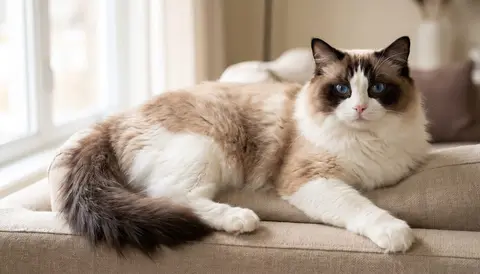
Ragdoll cats are large, blue-eyed, semi-longhaired cats with darker colored points, bred in California in the 1960s for a calm, people-oriented nature. The CFA describes them as docile, affectionate and playful cats that like to stay close to their people. They grow slowly, taking up to about four years to reach full size, and their silky coat needs less work than it looks.
The breed also carries a known heart risk. Some Ragdolls inherit a gene variant linked to hypertrophic cardiomyopathy (HCM), and a DNA test for it exists, so it pays to know what to ask before you bring one home. The breeder questions are near the end of this page, after the breed's history, daily care and the other health problems worth watching for.
What is a Ragdoll like at a glance?
| Trait | What to expect |
|---|---|
| Size | A large breed. The GCCF says males often weigh over 6 kg (about 13 lb) and females 4 to 6 kg |
| Growing up | Slow to mature: up to about four years to reach full size |
| Coat | Semi-long and silky, with little woolly undercoat |
| Eyes | Always blue |
| Patterns | Colorpoint, mitted, bicolor and van, in six point colors |
| Temperament | Calm, affectionate, playful and fairly quiet |
| Grooming | A comb through once or twice a week |
| Health to ask about | HCM, the inherited heart disease with a Ragdoll DNA test |
Where do Ragdoll cats come from?
The breed began in the 1960s with Ann Baker, a breeder in Riverside, California, who worked from a white longhaired cat called Josephine. The GCCF notes that Baker trademarked the name and ran her own registry, and that the standard most registries use today was developed later by a breakaway group of breeders.
Recognition followed slowly. The CFA accepted Ragdolls for registration in 1993 and for championship status in 2000, and the GCCF recognised the breed in the UK in 1990. The breed is now common: a 2025 study of UK veterinary records found that Ragdolls rose from 0.70% of cats born in 2005 to 3.72% of those born in 2019.
What does a Ragdoll look like?
Every Ragdoll is a pointed cat: the body is lighter, and the face, ears, legs and tail carry the darker color. The CFA lists six point colors (seal, blue, chocolate, lilac, red and cream), each of which can be solid, lynx (with tabby stripes), tortie or lynx-tortie. The eyes are always blue.
Kittens are born white, and the GCCF says the points start to show a few days after birth and keep developing as the kitten grows. The CFA says the full coat color takes about two years. Adults often grow a thick ruff around the neck and fluffy fur on the back legs, and the GCCF describes a ruff and these 'knickerbockers' on mature cats.
What colors do Ragdolls come in?
The CFA lists six point colors. Each one is shown here on a mitted cat, so only the color of the points changes. Any of them can also come with lynx (tabby) or tortie markings.


What are the Ragdoll patterns?
| Pattern | Where the white is |
|---|---|
| Colorpoint | No white: darker mask, ears, legs and tail on a lighter body |
| Mitted | White front paws like mittens, white boots on the back legs, a white chin and a white stripe along the belly |
| Bicolor | A white upside-down V on the face, with white legs, chest and underside |
| Van (in the CFA standard) | Mostly white, with color only on the ears, mask and tail |


How does a Ragdoll change as it grows?
The same seal mitted pattern at four ages. Kittens start out almost white, the points darken over the first two years, and the ruff and size keep filling out until the cat is about four.


What is a Ragdoll cat's temperament like?
The CFA describes Ragdolls as placid and affectionate, generally gentle with children and other pets, and not very talkative. They are still cats that need to play. The GCCF calls play-based exercise essential for keeping a Ragdoll fit, and early handling as a kitten shapes how sociable an adult becomes.
The name comes from the idea that a Ragdoll goes limp and relaxes completely in your arms. Some do, but the GCCF dismisses the floppiness as hype, and it calls the old claims about how Ragdolls feel pain dangerous: clinical tests show they respond like any other cat. Treat a Ragdoll like any cat: support its back legs when you lift it, and watch for signs of pain or illness just as closely.
Is a Ragdoll right for your home?
- You want a cat that follows you around and likes company more than independence
- You can give it play every day, so a calm cat does not become an overweight one
- You have room for a large cat: a big litter box, a sturdy scratching post and a cat tree that will not tip
- You are happy to comb a semi-long coat each week, with more during seasonal shedding
- You can budget for regular vet checkups, including heart checks if your vet advises them
- You will ask a breeder for the parents' health test results, or take a rescue cat's history as it comes
How do you care for a Ragdoll?
Feed to your cat's body condition
Ragdolls are big on paper, but the 2025 UK study found a median adult weight of 4.46 kg (about 9.8 lb), and obesity was one of the three most common problems recorded. Feed by calories and body condition, and ask your vet what a healthy weight looks like for your cat.
Play every day
A calm cat can be a sedentary one. Short sessions with a wand toy or a toy it can chase keep a Ragdoll moving, especially if it lives indoors. Food puzzles add a little work to mealtimes.
Look after the teeth
Dental problems were the most common disorder group in the UK study, recorded in about one Ragdoll in seven. Ask your vet to check the teeth at each visit and how you can help at home.
Keep up regular vet visits
An annual checkup is where a vet can listen to the heart, weigh your cat and catch kidney or dental changes early. Tell your vet your cat is a Ragdoll and whether its HCM gene status is known.
What health problems do Ragdoll cats have?
The best known is hypertrophic cardiomyopathy (HCM), a thickening of the heart's main pumping chamber. Cornell Feline Health Center calls it the most common heart disease in cats and lists Ragdolls among the breeds where it appears. It notes that many cats with HCM do not appear to be ill, and that an echocardiogram (a heart ultrasound) is the standard way to diagnose it.
In Ragdolls, one DNA variant in the MYBPC3 gene, called R820W, is linked to the disease, and a DNA test can find it. A cat can carry no copies, one or two. In a 2014 survey of 236 tested Ragdolls, cats with two copies lived a median of 5.65 years. For cats with one copy or none, the median was longer than the study could measure, past 15 years.
A clear result is reassuring but not a guarantee. The test looks for this one variant only, and a university lab that runs it notes that a cat without it may still develop heart disease from other gene variants nobody has identified yet. So a cat with a clear gene test still needs a vet's heart checks.
Ragdolls also appear in studies of kidney and urinary problems. A 2023 study of UK referral cases found Ragdolls among five breeds with higher odds of stones in the kidneys or ureters than non-pedigree cats, and kidney disorders were the most common recorded cause of death in the 2025 study. Polycystic kidney disease, an inherited kidney condition, is seen most often in Persians, according to Cornell Feline Health Center. Ask a breeder which kidney screening, if any, the parents had.
How long do Ragdoll cats live?
A typical Ragdoll lives into its early teens. In the 2025 study of UK veterinary records, the median age at death of the 133 Ragdolls that died during the study year was 12.85 years. The GCCF gives a lifespan of about 12 to 17 years. Many live longer, and inherited heart disease in cats with two copies of the HCM variant is one reason some die much younger.
Should you get a Ragdoll from a breeder or a rescue?
A breeder and a rescue can both be a good source of a Ragdoll. A breeder can show you the parents' health records, which matters for a breed with a known heart gene. The GCCF has required HCM DNA testing for Ragdoll breeding cats registered since 24 February 2016, and it advises buyers to ask for the parents' results. A breeder who cannot show them is a reason to keep looking.
Ragdolls and Ragdoll crosses also turn up in shelters and breed rescues, often as adults whose size and personality you can see up front. An adopted cat's genetic history is usually unknown, so ask the rescue what health checks it has had and plan a vet visit soon after it comes home.
What should you ask a Ragdoll breeder?
- Have both parents been DNA tested for the HCM variant, and can I see the results?
- Have the parents had heart scans, and when were they last checked?
- Which other health screening do you do, for example for the kidneys?
- Is the kitten registered with a recognized registry such as the CFA or GCCF?
- Can I meet the kitten with its mother, in the home where it was raised?
- How has the kitten been handled and socialized, and what has it eaten?
- Will you take the cat back if I can no longer keep it?
Gear for a large cat
Questions about Ragdoll cats
Are Ragdoll cats good for first-time owners?
Ragdolls often suit first-time owners. The CFA describes them as placid, affectionate and loving without being demanding, and their coat needs only weekly combing. Plan for a large cat that needs daily play and regular vet checks, and ask about the parents' HCM test results.
How big do Ragdoll cats get?
Ragdoll cats get large for a cat. The GCCF says males often weigh over 6 kg (about 13 lb) and females 4 to 6 kg, and the CFA says it is not unusual for a mature male to reach 20 lb or more. They can take up to about four years to reach full size.
Do Ragdolls shed a lot?
Ragdolls shed less than their semi-long coat suggests. The CFA says shedding is mostly seasonal and lighter than in breeds with a dense undercoat. A weekly comb keeps loose hair down, with extra sessions when it sheds with the seasons.
Can Ragdolls live indoors?
Ragdolls can live indoors, and many do; the CFA's description of a placid, not very talkative cat fits indoor life. An indoor Ragdoll still needs daily play, things to climb and scratch, and a watch on its weight, because the GCCF calls play-based exercise essential for keeping the breed fit.
Are Ragdolls hypoallergenic?
Ragdolls are not hypoallergenic, and no cat breed is. Cats Protection says hypoallergenic cats do not exist: every cat makes the main cat allergen, Fel d 1, in its saliva and spreads it onto skin and hair while grooming. The Asthma and Allergy Foundation of America also says a truly non-allergic cat does not exist.
Can someone with a cat allergy live with a Ragdoll?
Some people with a cat allergy react to some cats more than others, because Cats Protection says each cat produces its own amount of allergen. Spend time with the cat you plan to adopt before you commit, and talk to your doctor about the allergy first. A Ragdoll's long coat does not make it a safer choice than other breeds.
Are Ragdolls good with children and other pets?
Ragdolls are generally gentle with children and other pets, according to the CFA's breed description, which calls them placid and affectionate. The GCCF adds that early handling as a kitten shapes how sociable an adult becomes. Teach children to lift a Ragdoll with its back legs supported, since it is a large, heavy cat.
What is the HCM test for Ragdolls?
The HCM test for Ragdolls is a DNA test for R820W, a variant of the MYBPC3 gene linked to hypertrophic cardiomyopathy in Ragdolls. Cats with two copies are at the highest risk. A clear result does not rule out HCM from other causes, so ask your vet about heart checks too.