
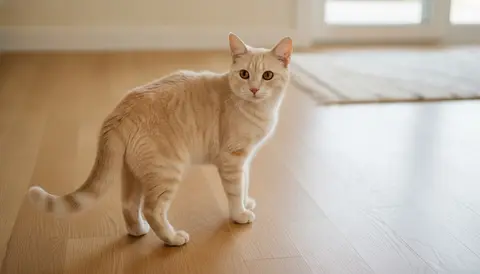
The quickest way to tell if your cat is overweight is to feel the ribs and look for a waist. At a healthy weight you can feel the ribs under a slight layer of fat, see a waist from above and see the belly tuck up from the side. Ribs you cannot feel, no waist and a rounded belly point to extra weight.
Vets put those checks together into a body condition score. WSAVA's chart runs from 1, very thin, to 9, heavily overweight, with 5 as ideal. The bathroom scale on its own says less than you might think, because cats differ in size and frame. VCA says body condition matters more than the number on the scale.
How do you check your cat's weight at home?
Feel the ribs
Run your flat hands gently along both sides of your cat's chest. VCA compares the feel to your own hand: ribs like the back of your hand suggest a good body condition, ribs like your knuckles may mean the cat is too thin, and ribs like the fleshy part of your palm may mean too much weight.
Look down from above
Stand over your cat while it stands or walks. Cats Protection says a cat at its ideal weight has a waist that tucks in slightly behind the ribs when seen from above. On WSAVA's chart the waist is hard to see at a score of 7 and gone at 8.
Look from the side
Crouch to your cat's level and look at the line of the belly. Cats Protection says the belly of a cat at a healthy weight is tucked up slightly behind the ribs. A belly that bulges out behind the ribs, or a rounded underside with a fat pad, is a sign of extra weight.
Feel along the back
Stroke along the spine with light pressure. Cats Protection says you should be able to feel the backbone under a thin covering of fat but not see it. WSAVA's chart lists fat over the lower back as a sign of a score of 8.

What does each body condition score look like?
| Score | Ribs | Waist and belly |
|---|---|---|
| 1 to 2: very thin | Easily seen on short-haired cats | Pronounced belly tuck; no fat pads; backbone obvious |
| 3 to 4: lean | Easily felt with minimal fat covering | Obvious or noticeable waist behind the ribs; slight belly tuck |
| 5: ideal | Felt with a slight fat covering | Waist seen behind the ribs but not pronounced; belly fat pad minimal |
| 6: slightly over | Felt with slight excess fat covering | Waist and belly fat pad present but not obvious; no belly tuck |
| 7: overweight | Not easily felt through moderate fat | Waist not easily seen; moderate belly fat pad; belly may be slightly rounded |
| 8 to 9: obese | Not felt under heavy fat | No waist; rounded or swollen belly; fat over the lower back, and at 9 the face and legs |
The table follows WSAVA's nine-point chart for cats. WSAVA adds that a score of 6 may be acceptable in some cats, especially older ones. Cornell Feline Health Center describes the same nine-point scale with 4.5 to 5 as ideal. If your vet gives your cat a score, ask which scale it is on.
Long fur hides a lot. WSAVA's descriptions of visible ribs apply to short-haired cats, so on a fluffy cat rely more on your hands than your eyes.
What are the signs your cat is overweight?
- You have to press to find the ribs, or cannot feel them at all
- No waist when you look down from above
- The belly hangs or bulges behind the ribs when seen from the side
- A pad of fat over the lower back near the tail
- Fat on the face and legs, which WSAVA's chart lists at a score of 9
- Your vet's notes show a score above 5, or weight creeping up between visits
How much overweight is too much for a cat?
A cat counts as overweight at 10 to 20 percent above its ideal body weight and obese at more than 20 percent above it, according to VCA. Cats Protection uses the same thresholds. Cornell Feline Health Center describes obesity as weight 20 percent or more above normal and calls it the most frequently observed nutritional disorder in domestic cats.
The percentages are small in kilograms. On a cat whose ideal weight is 4 kg (8.8 lb), 10 percent is 0.4 kg (under a pound). That is one reason weight gain goes unnoticed, and why your vet's record of your cat's weight over time is so useful.
Why does extra weight matter for a cat?
Extra weight matters for a cat because it raises the risk of several long-term diseases. VCA lists diabetes, osteoarthritis, heart disease and high blood pressure, bladder stones, some cancers and complications under anesthesia as more likely in overweight and obese cats than in lean ones. Cornell adds that obesity can make arthritis and diabetes worse.
Weight is also tied to lifespan. A 2018 study of 2,609 cats at a Sydney clinic found that cats whose highest score reached 9 tended to have shorter lives than cats that peaked at 6. VCA reports a 2.8-fold rise in deaths among obese cats aged 8 to 12 compared with lean cats. Cats that peaked below 5 also tended to die sooner in that study, so aim for the middle of the scale rather than the thinnest cat possible.
Why do cats become overweight?
Cats usually become overweight when they eat more calories than they use, and some everyday conditions make that easier. VCA says neutered and spayed cats have a greater risk of becoming overweight than intact cats, and that indoor cats face a greater risk because they often lead more sedentary lives.
Cornell Feline Health Center names free feeding, where dry food is left out all day, as a major factor in feline obesity. Treats add up too: VCA says they should make up no more than 10 percent of a cat's daily calories.
What should you do if your cat is overweight?
If your cat looks overweight, book a vet visit before changing its food. VCA says an obese cat should never be put on a diet without veterinary supervision. Your vet can weigh and score your cat, check for health problems, set a target weight and choose a food and daily amount for weight loss.
Slow loss is safer than fast loss. VCA puts the ideal at 1 to 2 percent of the starting weight a week, and closer to 0.5 percent for severely obese cats. Cornell gives a similar target of perhaps 1 or 2 percent a week. VCA advises weighing at least every other week until the goal is reached, with a clinic check about once a month.
Play helps a cat burn off what it eats. VCA suggests two ten-minute play sessions a day with toys such as feather wands. Our article on how much to feed a cat covers measuring meals and counting treats once your vet has set the amount.
What each source recommends
| Source | Scale | When it counts as overweight | Safe rate of loss | Home check |
|---|---|---|---|---|
| WSAVA | 1 to 9, with 5 ideal; 6 may be acceptable in some, especially older cats | Scores 6 to 9 are over ideal | Not stated | Ribs, waist behind the ribs, belly tuck and fat pads |
| VCA | Body condition matters more than the number on the scale | 10 to 20 percent above ideal weight; obese above 20 percent | 1 to 2 percent a week; about 0.5 percent if severely obese; vet supervised | Compare the ribs to the back of your hand, knuckles and palm |
| Cornell Feline Health Center | 1 to 9, with 4.5 to 5 ideal | Obese at 20 percent or more above normal | Gradual, perhaps 1 or 2 percent a week; vet supervised | Ribs, side profile and view from above |
| Cats Protection | No numbered scale | Overweight at 10 percent above ideal; obese above 20 percent | Not stated; speak to your vet | Waist from above, belly from the side, ribs and backbone |
Guides for measured meals and more play
Questions about telling if a cat is overweight
What is a healthy weight for a cat?
A healthy weight for a cat depends on its size and frame, so there is no single number. Cats Protection gives about 4 kg (9 lb) as an average that varies between cats. Body condition is the better guide: ribs you can feel under a slight layer of fat and a visible waist. Your vet can tell you your own cat's ideal weight.
Can I tell if my cat is overweight just by weighing it?
Weighing a cat alone cannot show whether it is overweight, because the right weight differs from cat to cat. VCA says body condition score matters more than the number on the scale. Weighing is still useful for tracking change: VCA suggests checking every 3 to 4 weeks, and a steady rise is worth raising with your vet.
How do I weigh my cat at home?
Weighing a cat at home works on an ordinary set of scales. Cats Protection suggests weighing yourself, then weighing yourself holding the cat, and subtracting the first number. You can do the same with the cat in its carrier and subtract the carrier's weight.
Is a saggy belly a sign my cat is fat?
A saggy belly on its own does not settle whether a cat is fat. Check the ribs and the waist too. On WSAVA's chart a cat at the ideal score still has a minimal belly fat pad, while an overweight cat also has ribs that are hard to feel and little or no waist. Your vet can tell loose skin from fat.
How fast should an overweight cat lose weight?
An overweight cat should lose weight slowly, under a vet's supervision. VCA's target is 1 to 2 percent of the starting weight a week, closer to 0.5 percent for severely obese cats, and Cornell gives a similar 1 or 2 percent. VCA warns that losing weight too fast risks muscle loss and hepatic lipidosis, a serious liver disease.