
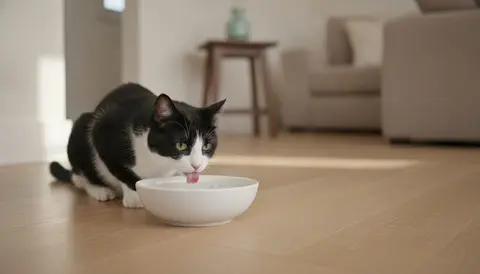
A cat needs roughly 4 ounces of water a day for every 5 pounds of body weight, so about 8 ounces, or one cup, for a 10-pound cat. That is VCA's figure, and VCA does not say whether it includes the water in food. Food can supply a large share of a cat's water, so how much your cat drinks from the bowl depends a great deal on what it eats.
A cat on canned food may drink very little and still be getting enough. A cat on dry food has to drink most of its water. Your own cat's normal tells you more than any single number does, because a clear change in drinking, up or down, is a reason to call your vet.
How much water does a cat need a day?
About 4 ounces per 5 pounds of body weight is VCA's rule of thumb, which works out to roughly 50 milliliters per kilogram. The National Research Council gives a similar 50 to 60 milliliters per kilogram, but a 2025 review of 32 studies in the Journal of Animal Science points out that this figure was based on dogs and does not account for diet, temperature or activity.
Measured intake in healthy cats has often come in lower. In the five studies the review found that reported it per kilogram, healthy cats took in about 23 to 51 milliliters of total water per kilogram a day. Treat the rule of thumb as a ballpark rather than a target. VCA also notes that needs change with the temperature of the home.
What each source says about daily water
| Source | Daily figure | What the figure covers | Other advice |
|---|---|---|---|
| VCA | About 4 oz per 5 lb of body weight (roughly 50 ml per kg) | A rule of thumb; VCA does not say whether water in food counts | Bowls in several places, washed daily; many cats prefer glass, metal or ceramic |
| National Research Council | 50 to 60 ml per kg | Based on dogs, says the 2025 Journal of Animal Science review, and ignores diet, temperature and activity | Not stated in the sources we used |
| Journal of Animal Science review (2025) | About 23 to 51 ml per kg of total water, as measured | Healthy cats in the five studies that reported intake per kg | Cats on wet food take in more water overall but drink less of it |
| Cornell Feline Health Center | No daily figure | Not applicable | Fresh water at all times; canned food is at least 75 percent water |
| AAFP/ISFM environmental needs guidelines (2013) | No daily figure | Not applicable | Water in several places, apart from food and well away from the litter box |
How much water is in cat food?
| Diet | Water in the food | What it means at the bowl |
|---|---|---|
| Canned (wet) food | At least 75 percent, per Cornell | Much of the day's water arrives with meals, so the cat drinks less from the bowl (VCA) |
| Dry food (kibble) | 6 to 10 percent, per Cornell | Most of the day's water has to come from drinking |
| A mix of both | Somewhere in between | Bowl drinking falls between the two, so watch for changes against your cat's own normal |
Why do cats drink so little?
Cats evolved to get much of their water from food. VCA explains that the water needs of wild cats were met by the prey they ate, while many pet cats now eat only dry kibble. Cornell's Feline Health Center calls canned food a good dietary source of water for the same reason.
Cats on wet food generally take in more water overall but drink less of it, according to the Journal of Animal Science review. So a cat that seldom visits the bowl is not necessarily short of water, and a cat on dry food that drinks often may simply be doing what its diet requires.
What does it mean if a cat drinks more than usual?
A cat that suddenly drinks noticeably more, or fills the litter box with more urine, should see a vet, because increased thirst is a sign of several common illnesses. Cornell's Feline Health Center lists increased thirst and urination among the signs of diabetes and of hyperthyroidism, and says cats with chronic kidney disease may drink more water to compensate.
Some of these conditions are more common in older cats. Cornell says hyperthyroidism mostly affects middle-aged and older cats, and that all senior cats should be regularly monitored for kidney disease. Some changes have simple explanations, like a switch from canned to dry food or a hot spell, but only your vet can rule out a medical cause.
How can you help a cat drink more water?
- Keep clean, fresh water available at all times (Cornell)
- Put water bowls in more than one place around the home (VCA, AAFP/ISFM)
- Keep water apart from food, and well away from the litter box (AAFP/ISFM, VCA)
- Give each cat in a multi-cat home room to drink without being crowded (AAFP/ISFM)
- Wash and rinse the bowl daily and change the water often (VCA)
- Try glass, metal or ceramic bowls, which VCA says many cats prefer to plastic
- Fill the bowl near the top, since some cats dislike their whiskers touching the rim (VCA)
- Try water at a different temperature: some cats like it cold, some at room temperature (VCA)
- Ask your vet whether more wet food would suit your cat
Do water fountains make cats drink more?
Water fountains do not reliably make cats drink more. In a 2010 study of 12 healthy cats in the Journal of Feline Medicine and Surgery, intake was only slightly higher from a fountain and urine was no more dilute. A 2019 laboratory study in the same journal found bowl type made no overall difference, though 3 of the 14 cats showed a preference for one kind of bowl.
A fountain can still suit a cat that likes moving water, and VCA lists one among its ideas to try. Keep a still bowl out as well so your cat can choose, and wash the fountain and change its filter on the maker's schedule. Our fountain comparison covers the cleaning and capacity differences between models.
Comparing fountains
Questions about how much water cats need
Is it normal for a cat on wet food to hardly drink?
A cat on wet food can drink very little and still get enough water. Cornell's Feline Health Center says canned food is at least 75 percent water, and VCA notes that cats eating canned food do not have to drink as much as cats on kibble. The thing to watch is a change from your cat's usual pattern, which is worth raising with your vet.
Can I add water to my cat's food?
VCA suggests adding small amounts of water to kibble and increasing it gradually, and going back to the usual food if your cat refuses it, because a cat should never go without eating. If your cat has a health condition or is on a special diet, ask your vet first.
How much water should a kitten drink?
No separate daily water figure for kittens appears in the VCA, Cornell or National Research Council guidance we used. Keep fresh water available at all times, as Cornell advises for every cat, and ask your vet at your kitten's checkups if you are unsure it is drinking enough.
My cat is drinking much more than usual. Should I give it more water?
A cat drinking much more than usual should keep free access to water and see a vet. Increased thirst is a sign of conditions such as kidney disease, diabetes and hyperthyroidism, according to Cornell's Feline Health Center, so the drinking itself needs a vet's attention rather than a change of bowl.